Custom Website vs. Template Website Which Is Right for Your Business
by
SigmaIT Softwares
Posted on 10/3/2026 5:25:34 PM
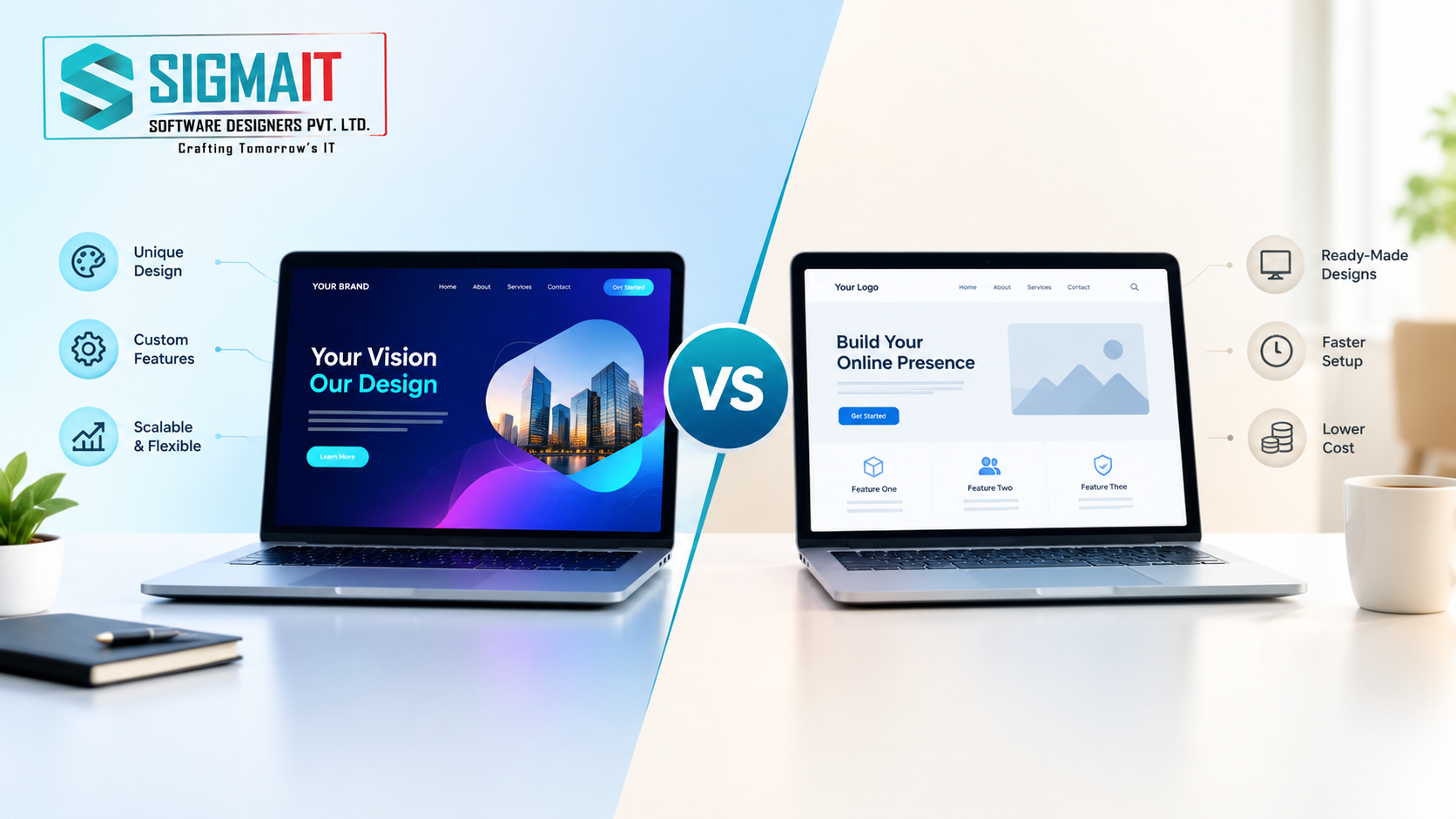
Choosing how to build a business website often starts with a simple question: should you use a ready-made template or invest in custom website development? At first, a template can seem like the obvious choice because it offers a faster setup and a lower starting cost. However, as business requirements become more specific, the limitations of a template may become more noticeable.
On the other hand, custom website development gives businesses greater control over design, functionality, performance, and future expansion. That does not automatically make it the right choice for every company. The better option depends on what the website needs to achieve, how much flexibility the business requires, and how the website may evolve.
What Is a Template Website?
A template website uses a pre-designed layout and structure created for repeated use. Platforms and content management systems often provide templates with ready-made sections for services, about pages, contact forms, blogs, galleries, and other common website elements. Businesses can then customise colours, images, text, fonts, and certain functions to match their brand.
For a small business that simply needs an online presence, this approach can work well. A consultant, local service provider, freelancer, or small company may not need complex functionality. Therefore, using a suitable website template can provide a practical way to launch without investing heavily in development.
What Is a Custom Website?
Custom website development creates a website around the specific requirements of a business. Instead of starting with a fixed layout and adapting the business to it, developers can plan the website's structure, design, features, integrations, and user experience according to the project's objectives.
For example, a real estate company may require property search and filtering, lead management, agent accounts, and enquiry integration. An education company may need student registration, course management, dashboards, and payment functionality. Custom development allows these requirements to become part of the website architecture.
Custom Website vs Template Website for Design Flexibility
Design flexibility is one of the clearest differences between the two approaches. A template provides a predetermined structure, so businesses usually work within the design system offered by the theme or template. While colours, images, typography, and some layouts can be changed, deeper modifications may require additional development.
A custom website provides much greater control over the interface. Designers can create layouts around the brand identity, target audience, content structure, and customer journey. As a result, businesses can create a website that looks and functions differently from competitors instead of relying on a commonly used design.
Custom Website vs Template Website for Functionality
Functionality often becomes the deciding factor when comparing these two options. Templates generally provide common features that work for a broad range of businesses. However, a company may eventually require functionality that the selected template does not support properly.
Custom website development can accommodate business-specific features such as customer portals, advanced search, booking systems, dashboards, API integrations, CRM connections, payment gateways, inventory management, or specialised calculators. Consequently, businesses have more freedom to build functionality around their actual workflows.
Which Option Offers Better Performance and SEO?
Both approaches can produce a technically sound website, but the final result depends heavily on implementation. A poorly configured custom website can perform worse than a well-optimised template website. Therefore, businesses should evaluate the development quality rather than assuming that one approach automatically performs better.
A custom website can provide greater control over code, page structure, scripts, technical SEO elements, and performance optimisation. At the same time, a good template can also be optimised through proper image compression, caching, responsive design, clean content structure, and careful plugin management. SEO should be planned during development so the website is optimised before it goes live.
Website Development Cost and Budget Considerations
Cost is usually one of the first differences businesses notice. Template websites generally require a lower initial investment because much of the design and structure already exists. Businesses may pay for the template, hosting, plugins, customisation, development support, and other services depending on the platform.
Custom website development usually requires a larger initial investment because designers and developers create more elements specifically for the project. Website development costs can increase further when a website requires custom functionality, third-party integrations, ecommerce capabilities, advanced security, or complex backend systems. However, businesses should consider the long-term value and requirements rather than comparing only the initial development price.
Which Website Is Easier to Maintain?
A template website can be relatively straightforward to manage when it uses a stable platform and a limited number of extensions. However, problems can arise when a business relies on many plugins or third-party components. Updates may create compatibility issues, and unnecessary additions can affect website performance.
Custom websites require ongoing technical maintenance as well, particularly when they use specialised functionality. However, a well-structured custom system can make it easier to control which features exist and how different components interact. Regular security updates, backups, performance checks, bug fixes, and content updates remain important regardless of the development approach.
Which Option Is Better for Business Growth?
A template website can be sufficient when the business has relatively straightforward requirements and does not expect significant changes to its online operations. It can provide a practical starting point while the company establishes its online presence.
However, businesses with plans for advanced functionality may benefit from a more flexible foundation. Custom development can allow new modules, integrations, customer areas, e-commerce functionality, or internal systems to be added as requirements change. Therefore, companies should consider not only what they need today but also what the website may need to support in the future.
How to Choose Between a Custom and Template Website
Start by defining what the website needs to accomplish. If the primary goal is to display services, provide company information, publish content, and generate basic enquiries, a template may meet those requirements. In that situation, investing heavily in custom functionality may not provide enough additional value.
However, if the website needs unique workflows, advanced integrations, specialised user experiences, or complex business functionality, custom development deserves serious consideration. Businesses should also evaluate their budget, expected traffic, maintenance capabilities, SEO requirements, security needs, and long-term plans before making a decision.
Final Takeaways for Choosing the Right Website
The custom website vs template website decision is not about choosing the option that sounds more advanced. It is about matching the development approach with the business's actual requirements.
A template can provide speed, simplicity, and a lower starting cost for businesses with standard needs. Custom website development can provide greater control, flexibility, and scalability when a business requires specialised functionality. Before starting development, document the required features, plans, budget, SEO needs, integrations, and maintenance expectations. Then choose the approach that supports those requirements without paying for functionality the business does not actually need.