mobile app development cost in india
by
SigmaIT Softwares
Posted on 4/30/2026 5:23:31 PM
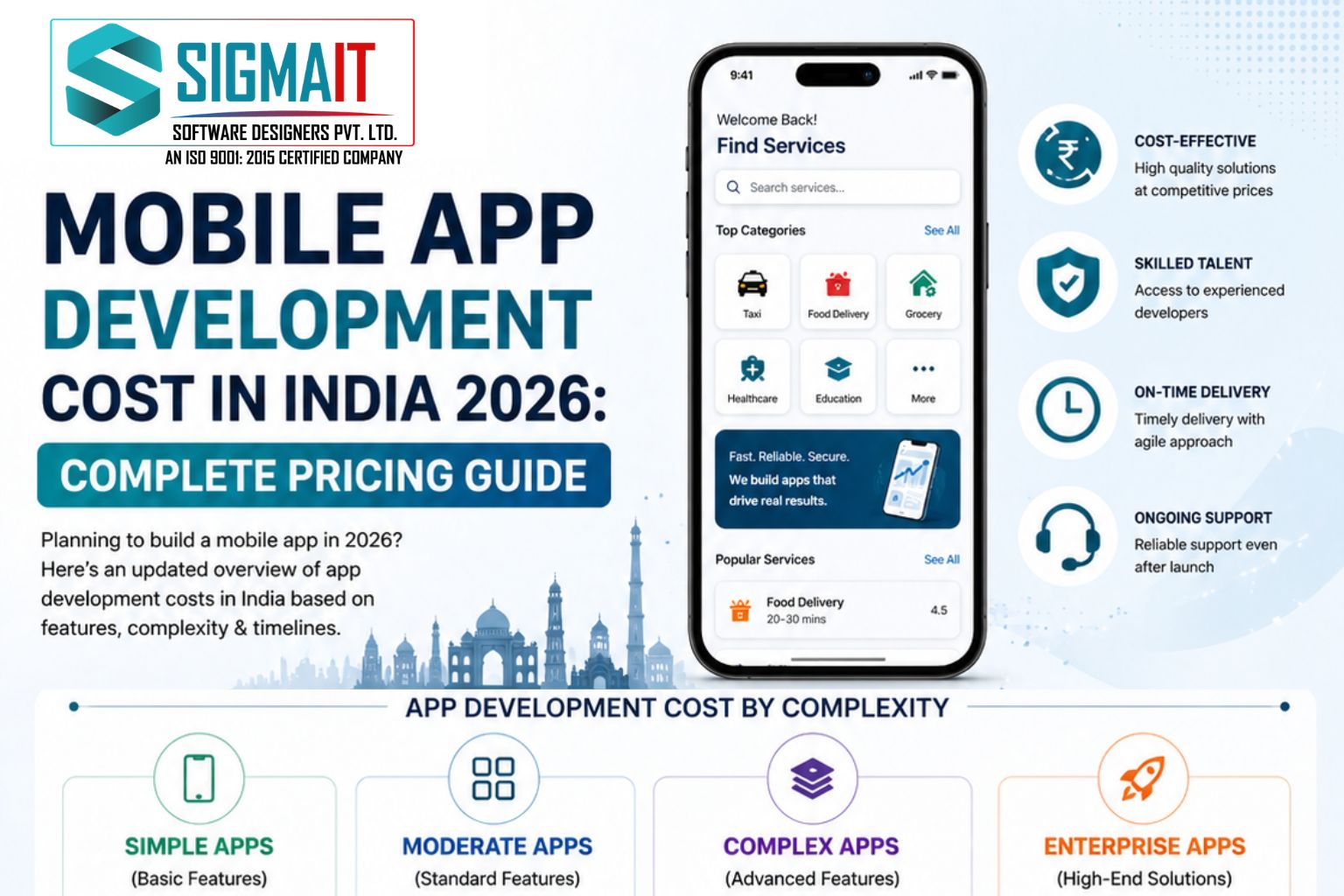
Mobile App Development Cost in India 2026: Complete Pricing Guide
Planning to build a mobile app in 2026 but not sure how much it will cost? You are not alone. The mobile app development cost in 2026 has changed significantly over the last few years - thanks to new technologies, global talent availability, and shifting business needs. Whether you are a startup founder or an established business, understanding the application development cost upfront is one of the smartest things you can do before writing a single line of code.
Why Startups Are Investing Heavily in Mobile Apps?
In 2026, mobile apps are no longer a luxury - they are a business necessity. From food delivery to healthcare, startups are using apps to reach customers faster and at scale. A well-built app lowers customer acquisition costs, boosts retention, and opens new revenue streams. That is why more startups than ever are setting a clear app development budget before they even hire a designer.
Overview of App Development Cost Trends in 2026
The cost to make an app has become more flexible in 2026. On one hand, AI-assisted tools and low-code platforms have brought down timelines. On the other hand, demand for richer experiences and tighter security has pushed up the complexity of projects. The result? Costs vary more than ever - and knowing the right benchmarks for your specific requirement is critical.
Importance of Budgeting Before Starting App Development
Jumping into app development without a budget is like starting a road trip without fuel. Many businesses end up spending 40–60% more than planned simply because they did not map out their app development cost estimate at the start. A realistic budget helps you choose the right team, avoid scope creep, and launch on time - without nasty financial surprises along the way.

What is the Average Cost to Develop an App in 2026?
There is no one-size-fits-all answer to the cost of developing an app - and anyone who gives you a number without asking questions first should be treated with caution. That said, here is what real-world projects actually cost in 2026, based on app complexity, team location, and functionality. Think of these as starting ranges, not fixed quotes.
1. Cost Range for Basic, Medium, and Complex Apps
Basic app development cost typically falls between ₹3–8 lakhs. Medium complexity apps - with user logins, dashboards, and payment integration - generally cost ₹10–30 lakhs. Complex apps with AI, real-time features, or marketplace functions can exceed ₹50 lakhs depending on scope.
| App Complexity |
Estimated Cost (India) |
Estimated Cost (Global) |
| Basic / Simple |
₹3 – ₹8 Lakhs |
$5,000 – $15,000 |
| Medium Complexity |
₹10 – ₹30 Lakhs |
$20,000 – $60,000 |
| Complex / Enterprise |
₹40 Lakhs+ |
$80,000 – $300,000+ |
2. Estimated Cost in India vs Global Markets
India has become a global leader in mobile app development - not just because of lower costs, but because of genuine technical expertise. The average mobile app cost in India is 50–70% less compared to the US, UK, or Australia. A mid-level app that costs $60,000 in the US can be built for ₹15–20 lakhs in India with a quality team - without compromising on quality.
3. Cost Variation Based on Business Requirements
Your specific business requirements - number of screens, supported platforms, third-party integrations, and user volume - directly shape your app development price. An app built for 500 users functions very differently from one built for 5 million. Custom workflows, industry-specific compliance, and real-time sync features all add to the final cost. Always define your requirements clearly before asking for a quote.
Mobile App Development Cost Breakdown
When you hire a team to build your app, you are not just paying for someone to write code. The total business app development cost includes multiple phases — each with its own team, timeline, and price tag. Understanding this breakdown helps you know exactly what you are paying for, catch unnecessary expenses early, and avoid those awkward conversations when invoices arrive.
1. UI/UX Design Cost
Good design is not decoration — it directly affects how many users stick with your app. UI/UX design typically accounts for 15–25% of the total project cost. For a medium-complexity app in India, expect to budget ₹1.5–5 lakhs for wireframes, visual design, and prototypes. Skimping here often leads to expensive redesigns after launch.
2. Frontend and Backend Development Cost
Frontend development (what users see and interact with) and backend development (the logic, databases, and servers that power your app) together form the largest share of your application development cost — typically 50–60% of the total. In India, combined frontend and backend development for a medium app ranges from ₹8–20 lakhs, depending on features and technology stack.
3. API Integration and Third-Party Services Cost
Most modern apps rely on third-party APIs — payment gateways, maps, SMS, social logins, and more. The cost of integrating these services can range from ₹50,000 to ₹3 lakhs depending on the number and complexity of integrations. Some APIs also carry monthly usage fees that become part of your ongoing operational cost after launch.
4. Testing and Quality Assurance Cost
QA testing usually takes up 15–20% of the total development cost, but it is money well spent. A bug discovered in production costs 10x more to fix than one caught in testing. For Indian projects, budget ₹1–4 lakhs for thorough functional, performance, and security testing. Do not skip this phase to save money — it almost always costs more later.
5. Deployment and Launch Cost
Deploying your app to the Google Play Store and Apple App Store is not free. Developer account fees, final QA runs, server configuration, and App Store review preparation add up. Budget ₹30,000–₹1 lakh for a clean deployment. For enterprise apps with complex backend setups, this can go higher depending on cloud infrastructure requirements.
Key Factors That Affect Cost to Build a Mobile App
Two apps can look similar on paper but have wildly different price tags. The cost to get an app developed is shaped by a combination of technical decisions, business goals, and team choices. Understanding these factors helps you make smarter tradeoffs — spending more where it matters and saving where it does not affect your users' experience.
1. App Complexity and Features
Every feature you add takes time, and time costs money. A simple app with five screens and basic user registration is a completely different project from one with real-time chat, custom dashboards, and multi-role access. Before finalising your app development budget, list your must-have features separately from nice-to-haves. This alone can bring your initial estimate down by 30–40%.
2. Platform Choice (Android, iOS, or Cross-Platform)
Building natively for both Android and iOS means building two separate apps — which roughly doubles your development cost. Cross-platform frameworks like Flutter or React Native let you write one codebase for both platforms, reducing the mobile app development price significantly. For most startups in 2026, cross-platform is the smart first choice unless you have a specific reason to go native.
3. UI/UX Design Complexity and Custom Animations
A clean, functional design costs less than a highly customised experience with micro-animations, custom illustrations, and complex interactions. While great design improves retention, be practical about what serves your users versus what serves your ego. Custom animations and motion design can add ₹2–5 lakhs to your budget without proportional returns for most business apps.
4. Technology Stack (Flutter, React Native, Native)
Your choice of technology stack affects not just the build cost but also long-term maintenance. Flutter and React Native are cost-effective and popular in 2026. Native development (Swift for iOS, Kotlin for Android) gives the best performance but at a higher cost. The right stack depends on your app type, team availability, and long-term scalability needs.
5. Backend Infrastructure: APIs, Databases, and Cloud Services
The backend is the engine under the hood. A simple app might run on basic shared hosting, while a high-traffic platform needs scalable cloud infrastructure on AWS, Google Cloud, or Azure. Scalable backend architecture adds ₹3–15 lakhs to the build cost but saves you from painful rebuilds when your user base grows. Plan for scale early — it is cheaper than re-architecting later.
6. Development Team Location and Expertise
Where you hire android app developer or iOS developer significantly impacts your total cost. Developers in the US charge $100–$200/hour; European developers $70–$150/hour. In India, experienced developers charge $20–$50/hour — roughly 3–5x less for comparable quality. However, location is only one factor — the team's experience, communication quality, and project management practices matter just as much.
7. App Security and Compliance Requirements
Apps in healthcare, finance, or e-commerce must meet strict security and regulatory standards. Implementing SSL, data encryption, GDPR compliance, or healthcare data regulations adds to your cost — typically ₹1–4 lakhs depending on the compliance requirements. Cutting corners here is never worth it; a data breach can cost far more in reputation and legal fees.
Cost to Build an App by App Type
Not all apps are built the same. A fitness tracker works very differently from a banking app, and their costs reflect that. Here is a practical breakdown of mobile app cost by app type, so you can benchmark your project against similar products already in the market. These are real-world estimates based on current development rates in India.
| App Type |
Cost in India |
Timeline |
| MVP / Prototype |
₹2 – ₹6 Lakhs |
4 – 8 Weeks |
| E-commerce App |
₹8 – ₹25 Lakhs |
3 – 6 Months |
| Social Media / Marketplace |
₹15 – ₹40 Lakhs |
4 – 8 Months |
| On-Demand (Uber/Swiggy Model) |
₹12 – ₹35 Lakhs |
3 – 7 Months |
| Healthcare / Fintech |
₹20 – ₹60 Lakhs |
6 – 12 Months |
| AI-Powered App |
₹25 Lakhs+ |
6 – 12+ Months |
1. MVP / Prototype App Cost
If you want to test your idea before committing to a full build, an MVP (Minimum Viable Product) is your best friend. Simple app development cost for an MVP in India ranges from ₹2–6 lakhs. It covers core features only — enough to validate your concept, attract early users, and get investor interest. Most successful apps today started as lean MVPs.
2. E-Commerce App Cost
Ecommerce app development cost in India typically starts at ₹8 lakhs and can go up to ₹25 lakhs for a full-featured platform with product listings, cart, payments, order tracking, and seller dashboards. Adding features like AI-based product recommendations, loyalty programmes, or multi-vendor marketplaces will push the cost higher.
3. Social Media / Marketplace App
Building a social media or marketplace app is one of the more expensive categories because of real-time messaging, user-generated content, recommendation algorithms, and moderation systems. Expect to budget ₹15–40 lakhs for a solid foundation. Scaling such apps post-launch also requires significant backend investment as the user base grows.
4. On-Demand App (Uber/Swiggy Model)
On-demand apps involve multiple interfaces — a customer app, a service provider app, and an admin panel. Real-time location tracking, dynamic pricing, and push notifications add to the complexity. The business app development cost for this model in India ranges from ₹12–35 lakhs. Logistics and matching algorithms add further complexity and cost.
5. Healthcare / Fintech App
Apps in regulated industries like healthcare and fintech require extra investment in security, compliance, and testing. HIPAA, RBI guidelines, or insurance regulatory requirements add legal and technical layers to your build. Budget ₹20–60 lakhs for such apps in India. The returns on well-built healthcare and fintech apps, however, are often substantial.
6. AI-Powered App
AI-powered apps — those using machine learning, natural language processing, or computer vision — are a growing category in 2026. Building custom AI models adds significantly to cost; using pre-trained APIs (like OpenAI or Google Vision) is more affordable. Expect to start at ₹25 lakhs and go upward depending on the complexity of the AI functionality required.
Cost by Development Approach: Native vs Cross-Platform vs No-Code
Choosing how to build your app is one of the biggest cost decisions you will make. Each development approach has its own trade-offs in terms of app development price, performance, and long-term maintainability. There is no universally right answer here — the best choice depends on your timeline, budget, target users, and how quickly your product needs to evolve.
1. Native iOS (Swift) and Android (Kotlin) Development: Costs and Benefits
Native development gives you the best performance and access to platform-specific features. But it also means building and maintaining two separate codebases, which roughly doubles your development cost and timeline. In India, native development for both platforms can cost ₹20–50 lakhs for a medium-complexity app. It is ideal for apps where performance is non-negotiable, like gaming or advanced hardware integrations.
2. Flutter vs React Native: Which Saves More Money in 2026?
Both Flutter and React Native are cross-platform frameworks that let one team build for Android and iOS simultaneously. In 2026, Flutter has a slight edge in performance and UI consistency, while React Native benefits from a larger developer ecosystem. Both reduce mobile app development price by 30–50% compared to native. For most startups, Flutter is currently the more cost-effective and future-ready choice.
3. Low-Code / No-Code Platforms
Platforms like FlutterFlow, Bubble, or Adalo let non-technical founders build functional apps without traditional coding. They are excellent for simple use cases and early validation. However, they come with limitations — customisation is restricted, scalability can be an issue, and migrating off these platforms later can be expensive. Use them to test ideas, not to build production-grade platforms.
4. Progressive Web Apps (PWAs) as a Cost-Saving Alternative
PWAs are web apps that behave like native apps — they work offline, send push notifications, and can be added to a home screen. They cost significantly less to build than native apps since they run in a browser. For businesses that do not need deep hardware access or App Store presence, a PWA can cut the cost to make an app by 40–60% compared to native development.
5. Which Option Is Best for Startups in 2026?
For most Indian startups with a limited budget and an eye on speed, Flutter-based cross-platform development is the go-to choice in 2026. It offers near-native performance, a single codebase for both platforms, and a growing talent pool in India. Start with Flutter for your MVP, validate the market, and move to native only when the business case demands it.
Hidden Costs in Mobile App Development
The price your developer quotes is rarely the final number you spend. Hidden costs have a way of showing up after launch — and they can be significant. Most app development cost estimate guides skip this section entirely. We are not going to do that. Here is what you should budget for beyond the initial build — because these costs are just as real as the development invoice.
1. App Maintenance and Updates
Apps need regular updates to stay compatible with new OS versions, fix bugs, and introduce improvements. Maintenance is an ongoing cost that most first-time app owners underestimate. Plan for ₹50,000–₹2 lakhs per year for a basic app, and more for complex platforms. Ignoring maintenance is not a cost-saving strategy — it is a ticking time bomb for your user experience.
2. Cloud Hosting, CDN, and Server Infrastructure Costs
Unless your app is purely offline (rare), you will need cloud servers to store data, serve content, and run your backend. AWS, Google Cloud, and Azure all offer pay-as-you-go pricing. For a new app, budget ₹5,000–₹30,000 per month depending on traffic. As your user base scales, so does this cost — which is why scalable architecture from day one matters so much.
3. App Store and Play Store Fees, Commissions, and Guidelines
Google charges a one-time ₹2,100 fee for a Play Store developer account. Apple charges $99/year for an App Store developer account. Both stores take a 15–30% commission on in-app purchases and subscriptions. Additionally, frequent guideline updates from Apple and Google may require app changes that cost developer time — another ongoing hidden expense.
4. QA Testing, Security Audits, and Compliance Costs
Post-launch security audits are often skipped but are critical for apps handling user data or financial transactions. A professional security audit can cost ₹1–5 lakhs depending on the app's complexity. For regulated industries, annual compliance reviews add further cost. Think of these as insurance — you hope you never need to claim, but you will be glad you paid if something goes wrong.
5. Post-Launch Maintenance: The '20% Rule' Explained
There is a widely cited rule in the software industry: annual maintenance costs approximately 20% of the original development cost. So if you spent ₹20 lakhs building your app, budget ₹4 lakhs per year for maintenance. This covers bug fixes, OS compatibility updates, minor feature additions, and server monitoring. Factor this into your total on-demand app development budget from day one.
6. Marketing and ASO Budget: What Most Guides Skip
Building the app is only half the job. Getting people to find and download it is the other half. App Store Optimisation (ASO), paid ads, influencer campaigns, and PR all cost money. New apps typically need ₹2–10 lakhs for an initial marketing push to gain traction. The best-built app in the world will not succeed without users — and users do not come for free.
How to Reduce Cost to Create an App Without Cutting Corners?
Reducing your mobile app cost does not mean building a half-baked product. It means making smarter decisions at every stage of development. The most successful apps are often not the most expensive ones — they are the ones built with clear thinking, the right tools, and a team that does not waste hours on things that do not matter.
1. Start with MVP (Minimum Viable Product)
An MVP lets you launch with just the core features your users actually need — nothing more. This approach reduces your initial simple app development cost dramatically and gets you to market faster. Real user feedback then guides what you build next. Airbnb, Instagram, and Uber all started as MVPs. You do not need to build everything at once — just build what matters first.
2. Choose the Right Development Approach to Avoid Rewrites
One of the most expensive mistakes in app development is choosing the wrong technology stack and then rewriting the app from scratch six months later. Spend time upfront evaluating your options — Flutter, React Native, native, or PWA — based on your actual needs. A rewrite doubles your cost. The right choice the first time saves you significantly.
3. Outsource to Cost-Effective Locations
Outsourcing to India is one of the most practical ways to reduce your cost to get an app developed without compromising quality. Indian development companies like SigmaIT Software offer experienced teams at a fraction of Western market rates. With proper communication processes and project management, outsourcing delivers excellent results — and the savings are real, often 50–70% compared to local development.
4. Use Open-Source Libraries and Pre-Built Solutions and APIs
You do not need to build everything from scratch. Open-source libraries for authentication, payments, maps, and notifications can save weeks of development time. Pre-built APIs for features like SMS verification (Twilio), payment processing (Razorpay), or analytics (Firebase) reduce both cost and risk. Use what already exists and invest custom development time where it actually differentiates your product.
5. Agile Development: Ship in Sprints, Not Big Releases
Agile development breaks your project into two-week sprints, with working features delivered at the end of each cycle. This approach keeps costs predictable, allows you to course-correct based on early feedback, and prevents the budget overruns that come from discovering problems late in a big waterfall project. Most quality app development companies in India follow agile methodologies as standard practice.
How Long Does It Take to Build a Mobile App?
Timelines and costs are directly linked — the longer a project takes, the more it costs. Understanding realistic development timelines helps you plan your launch, manage stakeholder expectations, and avoid the trap of choosing a vendor who promises unrealistically fast delivery at a low mobile app development price. Here is what to genuinely expect for each level of app complexity.
| App Type |
Timeline |
Key Phases |
| Simple / Basic App |
4 – 8 Weeks |
Design, Dev, QA, Launch |
| Medium Complexity App |
3 – 6 Months |
Design, Frontend, Backend, API, QA, Launch |
| Advanced / Complex App |
6 – 12+ Months |
Architecture, Design, Full Dev, Integrations, Security, QA, Launch |
1. Timeline for Simple Apps
If thinking about a digital brochure, a simple booking tool, or a single-feature utility then a basic app will be suitable for your business and can be built in 4–8 weeks by a focused team. This includes wireframing, UI design, development, and basic testing. If you are building an MVP to validate an idea quickly, this timeline is achievable without cutting important quality steps.
2. Timeline for Medium Complexity Apps
Apps with user accounts, databases, payment integration, push notifications, and an admin panel typically take 3–6 months to build properly. Rushing this timeline is one of the top reasons apps fail post-launch. Budget enough time for thorough QA and a soft launch period to iron out any real-world issues before your full go-to-market push.
3. Timeline for Advanced Apps
Complex apps with AI, real-time features, multiple user roles, or third-party marketplace integrations realistically take 6–12 months or more. The extra time goes into architecture design, extensive testing, security audits, and phased feature rollouts. Do not let anyone convince you a complex app can be properly built in 8 weeks — quality work takes the time it takes.
Why Choose a Mobile App Development Company in India?
India has established itself as one of the world's top destinations for mobile app development — and the reasons go well beyond just cost. From Bengaluru to Lucknow, Indian app development companies are delivering enterprise-grade apps for clients across the US, UK, Europe, and Southeast Asia. Here is why choosing an Indian partner makes smart business sense in 2026.
1. Cost Advantages Compared to Global Markets
The hiring android app developer cost in India is 50–75% lower than equivalent talent in the US or Europe. An experienced Indian developer charges $20–$50/hour compared to $100–$180/hour in Western markets. For a 6-month project, this difference can amount to savings of ₹30–70 lakhs — without any compromise in technical skill or project management quality.
2. Skilled Developers and Modern Technologies
India produces over 1.5 million engineering graduates every year, many of them specialising in mobile and web technologies. Indian developers are well-versed in Flutter, React Native, Swift, Kotlin, Node.js, and cloud platforms. Top development companies in India work with Fortune 500 clients and maintain international quality standards, making them genuinely competitive on a global scale — not just on price.
3. Growing Startup Ecosystem in India
India's startup ecosystem is now the third largest in the world. Cities like Bengaluru, Hyderabad, Pune, and Lucknow have thriving tech communities, accelerators, and funding networks. Indian development companies understand the startup mindset — lean builds, fast iterations, and cost-conscious decision-making. This shared context makes collaboration smoother and results more aligned with what founders actually need.
Future Trends Impacting App Development Cost in 2026
The app development landscape is not static — it shifts every year as new tools, technologies, and market forces emerge. Keeping an eye on these trends helps you make forward-thinking decisions about your app development budget and tech stack. Here are the three most significant trends reshaping how apps are built and priced in 2026.
1. AI and Automation in App Development
AI-assisted development tools — like GitHub Copilot and similar platforms — are meaningfully reducing the time developers spend on repetitive coding tasks. In 2026, skilled teams using AI tools can complete certain development tasks 20–40% faster, which translates into real cost savings for clients. However, AI tools assist good developers; they do not replace the need for experienced human judgement on architecture and product decisions.
2. Rise of Low-Code / No-Code Platforms
Low-code and no-code platforms are maturing rapidly. They now handle more complex logic than they did even two years ago, making them a viable option for a growing range of use cases. For startups that need a fast, affordable proof-of-concept, these platforms reduce the initial cost to make an app substantially. However, for production-scale apps with complex custom requirements, traditional development still wins on flexibility and performance.
3. Cloud and Scalable Architecture Impact
Cloud-native development has become the standard in 2026 — not an advanced option. Serverless architectures, containerisation, and managed cloud services reduce the time teams spend on infrastructure setup, lowering both the build cost and ongoing maintenance expense. Apps designed with cloud-native principles from the start also scale more affordably, avoiding the expensive re-architecture costs that often hit fast-growing startups.
Partner with SigmaIT Software to Get the Best Price for Your Mobile App Development
At SigmaIT Software, the best mobile app development company in Lucknow, we have spent years helping startups, SMEs, and enterprise businesses across India and globally build apps that actually work — on time, within budget, and built to scale. We understand that the cost to make an app is a serious investment, and we treat your budget with the same respect you do.
Whether you need a lean MVP to validate your concept, a full-featured ecommerce app development platform, or a complex AI-powered solution, we provide transparent pricing, honest timelines, and a dedicated team that communicates clearly at every stage. Our mobile app development price is competitive without being cheap — because we build apps that last, not apps that need to be rebuilt six months after launch.
Stop guessing your app development cost estimate. Talk to our team today and get a detailed, no-obligation quote tailored to your specific requirements. Let us help you build something your users will love — and your business will be proud of.
Get Your Free App Development Quote from SigmaIT Software!